quinta-feira, 7 de março de 2013

Destination: Agra and the Taj Mahal


After our short stay in mystical Varanasi and saying goodbye to some of our friends who went straight back to Kolkata, our group headed to the one spot that is present in each and every Indian trip, the city of Agra, in the state of Uttar Pradesh, home to one of the most celebrated man-made creations of all time: the Taj Mahal. In fact, the mystique over the building is so intense that few people even know it is located in Agra before coming to India, and that this city has actually more to offer than just the Taj – leading many people to stop by, take a few pictures of the marble wonder and go straight to Jaipur (for those on the Golden Triangle route) or back to Delhi.

Agra was first established in 1501 as a capital city for Sultan Sikander Lodi. However, the city was conquered by the Mughal Empire in 1526. Being a central city to Mughal power made Agra flourish, especially during the reigns of celebrated Mughal emperor Akbar and Shah Jahan. It was during this period that the main landmarks of the city, including the Taj, were built.

We arrived in Agra by sunrise, and were greeted right there on the station by an unexpected impressive view: Agra’s railway station is set at the shadows of the great red sandstone walls of the Agra Fort. We went through the all-too-constant hassle of negotiating a more-or-less-fair price with the rickshaw drivers, and found our way to our hotel, which was called Saniya Palace and was located near the South Gate of the Taj Mahal complex. We were very impressed by the incredibly good view of the Taj provided by the hotel’s rooftop restaurant, which gave us our first peek at the thing.


The view from our rooftop


After freshening up a little, and since we had been told that visiting the Taj Mahal by the early morning would be much better (good advice, for that matter), we invested our afternoon in a ride to the Agra Fort. The Fort was built for military use by Emperor Akbar in 1565, but Shah Jahan transformed it into a full-fledged palace with a lot of additions. Ironically, after his son overthrew him, the fort became his prison for the last eight years of his life, a gilded cage from where he could admire his creation, the Taj.


The fort is a very impressive building of high walls and lots of courtyards, some of them housing gardens, training grounds, public audience halls, or just beautifully decorated walkabouts.


Shah Jahal’s additions to the original project are easily recognizable as they are all built with white marble, as opposite to the red stone of the walls and main structures.


MADNESS? This... is... SPARTAAAAA


A part of the water collection and drainage system

After visiting the fort, we went to take a look at the so-called “Baby Taj”. This small but beautifully decorated mausoleum actually houses the remains of Princess Mumtaz Mahal’s grandfather, and is said to have inspired the general architecture of the actual Taj.


Since we had decided to pay the Taj Mahal a visit only on the next day’s morning, our driver took us to a small park located across the river that goes behind the Taj Mahal, where we were able to appreciate good views of it and a beautiful sunset.


We woke up at 4:00am and started the chilly walk from our hotel to the Taj’s South Gate.  As it happens so often in India, there was a slow, bureaucratic and highly inefficient security check system in place. We had to buy the very expensive ticket in booth that was relatively far away from the entrance (of coursew there were no signs or anybody explaining that to newcomers), and then wait long minutes in an even longer line until they started taking people in, checking their handbags and pockets, and allowing them into the complex. The catch is: EVERYBODY knows that tourists that come to the gate while it’s still dark (and there are hundreds of them every single day) are trying for a sunrise view of the Taj, but guards will not make a move to start the security check until it’s fully clear in the morning. The obvious result is that the front-liners literally RUN like crazy to get a picture of the thing BEFORE the swarm of people envelops everything.

That said, the Taj Mahal is really, truly, once-in-a-lifetime unforgettable experience. Much is said by contempt-filled backpackers about how “touristy” and “mainstream” the place is, but whoever goes there rarely, if ever, leaves disappointed.

The Taj Mahal was built by Shah Jahal as a mausoleum in honor of his beloved third wife, Mumtaz Mahal, who died at childbirth. The finest architects from Persia and Arabia, as well as the greatest stoneworkers and artisans of the known world were called to produce this wonder, made almost entirely of white marble. By early morning, the sunlight turns the impeccable white marble pink-reddish, further adding to its beauty.


One could spend all day walking through the remarkably well-tended gardens and still be impressed at the quiet beauty of the place. One could spend weeks going there everyday, circling the Taj and going in and  out of its chambers, and still be amazed at the wonderful marble inlays, the symmetry of the architecture, the beautiful Arabic calligraphy of the Quran’s chapters inscribed there, and everything else. Every single little and apparently insignificant space is filled with beauty of some form, and you can see how well-planned and carefully built the whole complex was. It is indeed one of the great, if not the greatest, feats of human endeavor, and it’s impossible not to be awe-struck. That guy must REALLY have loved his wife.


Our short stay in Agra was coming to an end, and we had to rush back to the hotel to pack our things and run to the station to catch our train to Jaipur. It was not without regret that we said our goodbyes to the Taj, a beautiful jewel in the middle of an otherwise scorching, unforgiving land. It was also parting time to some members of our group that were heading back to Kolkata. At least we’ll have this picture, and all the incredible memories of Agra, to cherish in the years to come.


Next stop: Rajasthan!

quinta-feira, 28 de fevereiro de 2013

Experience: Trekking in the Himalayas


The story of my trekking on the Nepali Himalayas, just like so many of the amazing things that have happened to me during my journey, starts with a dramatic twist in my travel plans. Initially, my trip to Nepal was supposed to be mainstream enough: go there, see some temples, check out Kathmandu and some beautiful stupas, visit Lumbini, Buddha’s birthplace, and that’s it. Nice and smooth. However, the goddess of indie travel had something else in mind for me, and her plans were in action even before I entered Nepal.

On February 11th, my friend Giselle and I, the only survivors from the 10-peoplegroup that left Kolkata on Jan 24th, took a train from New Delhi to Gorakhpur, meaning to cross the border into Nepal. On that train I have met a very friendly American couple, Sarah and David, and we have quickly warmed up to each other during the 16-hour ride. After crossing the border, we said our goodbyes to them, as we were headed to Kathmandu, and they were going to the Chitwa National Park elsewhere in Nepal.

After some days in Kathmandu, Giselle and I were walking on the street trying to find the correct bus stop to take a ride to Bhaktapur, a nearby city, when we heard a distinct “HEY!”. David and Sarah were having lunch in a restaurant we were passing in front of. It was a happy coincidence, and there I learned they were going trekking on some Himalayan trails in two days, and they kindly invited me in. Lucky me.

On the following day, I accompanied Sarah and David to a shop where they were going to buy some gear they needed, and right there on the spot I made up my mind to join them. I bought a synthetic T-shirt and a shirt, two trekking poles, a fleece jacket, cargo pants, rain jacket and pants, warm underpants, a hat, backpack cover, 3 pairs of socks, a Nalgene water bottle, all for a little over 115 dollars. I also rented a heavy jacket and a sleeping bag, and I was good to go.

The next sunrise found me and Giselle saying our goodbyes – after almost a month travelling together. I met David and Sarah and we took the bus to Shyafru Bensi, a little town at 1,500m high, just at the beginning of the Langtang Trail, our trekking route of choice. The bus ride was nightmarish: the only seats available were on the back of the bus, the bumpiest, least comfortable place in a non-comfortable-at-all bus. We thought we would die a thousand times: the Nepali drivers take no prisoners and the roads are narrow, bumpy, with endless abysses inviting us to a horrible death at every turn. I have made a little video , about it, though it does not convey the full atmosphere of the situation:


Luckily, the way was also beautiful, and the toilet breaks had an amazing scenery:

Do you have that view from your bus?

Pee-pee break

We reached a rainy Shyafru Bensi already battered up, and the trek had not even started! After dinner, we went over our trekking plans again at the hotel, and went to sleep hoping for clear skies and dreaming with the heights.
The War Room

On the next morning, we packed our things tight, stretched our trekking poles, and hit the trail. The Langtang Trail, named after the biggest village on the mountain, stretches all the way from Shyafru Bensi, at 1,500m, to Kianjin Gumba, at 4,000m, roughly following a big river, and combines spots of lush green and steep rocky stairways with large extents of snow trails and open plains surrounded by the beautiful snowy peaks of the Himalayas.

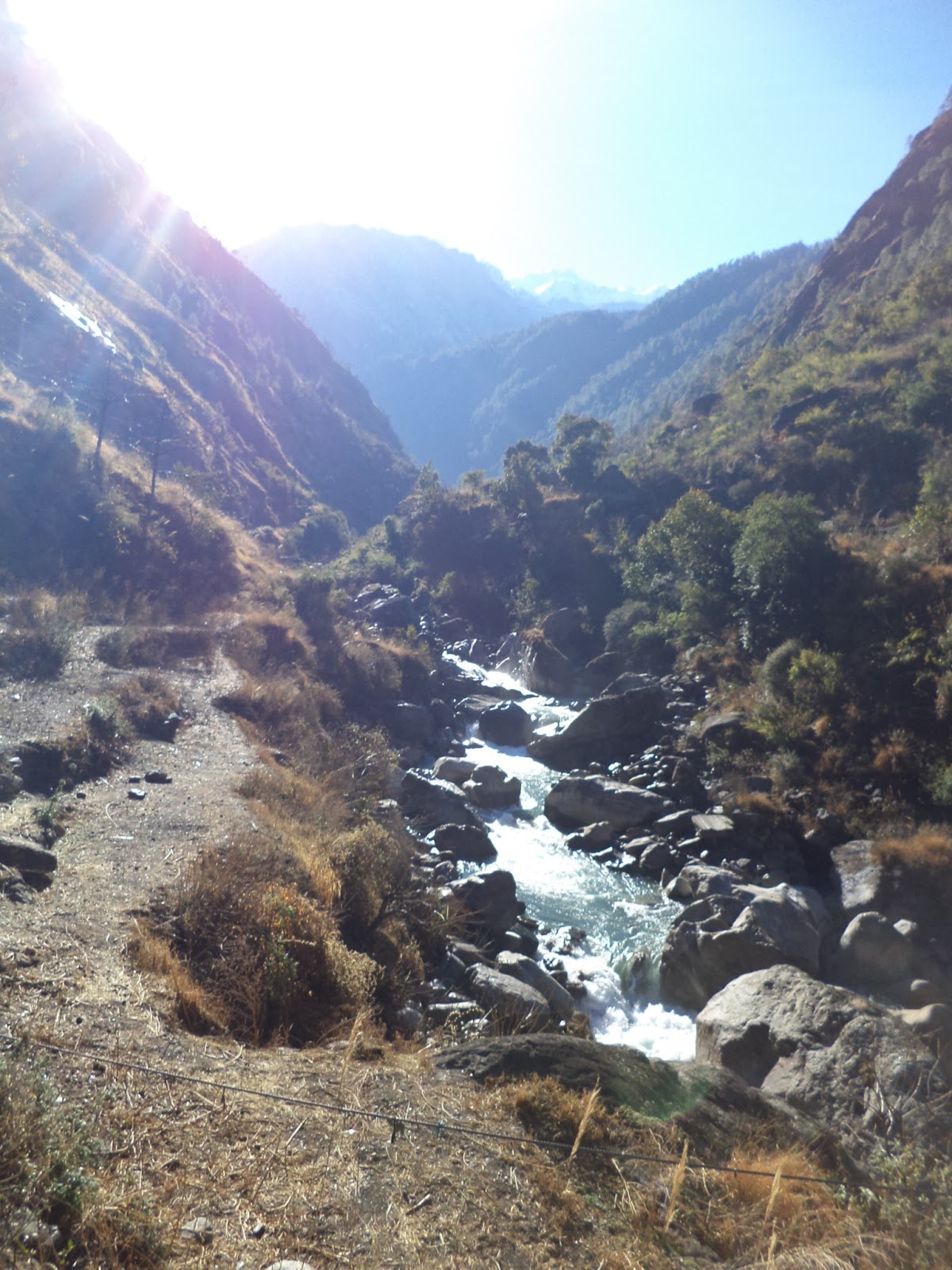
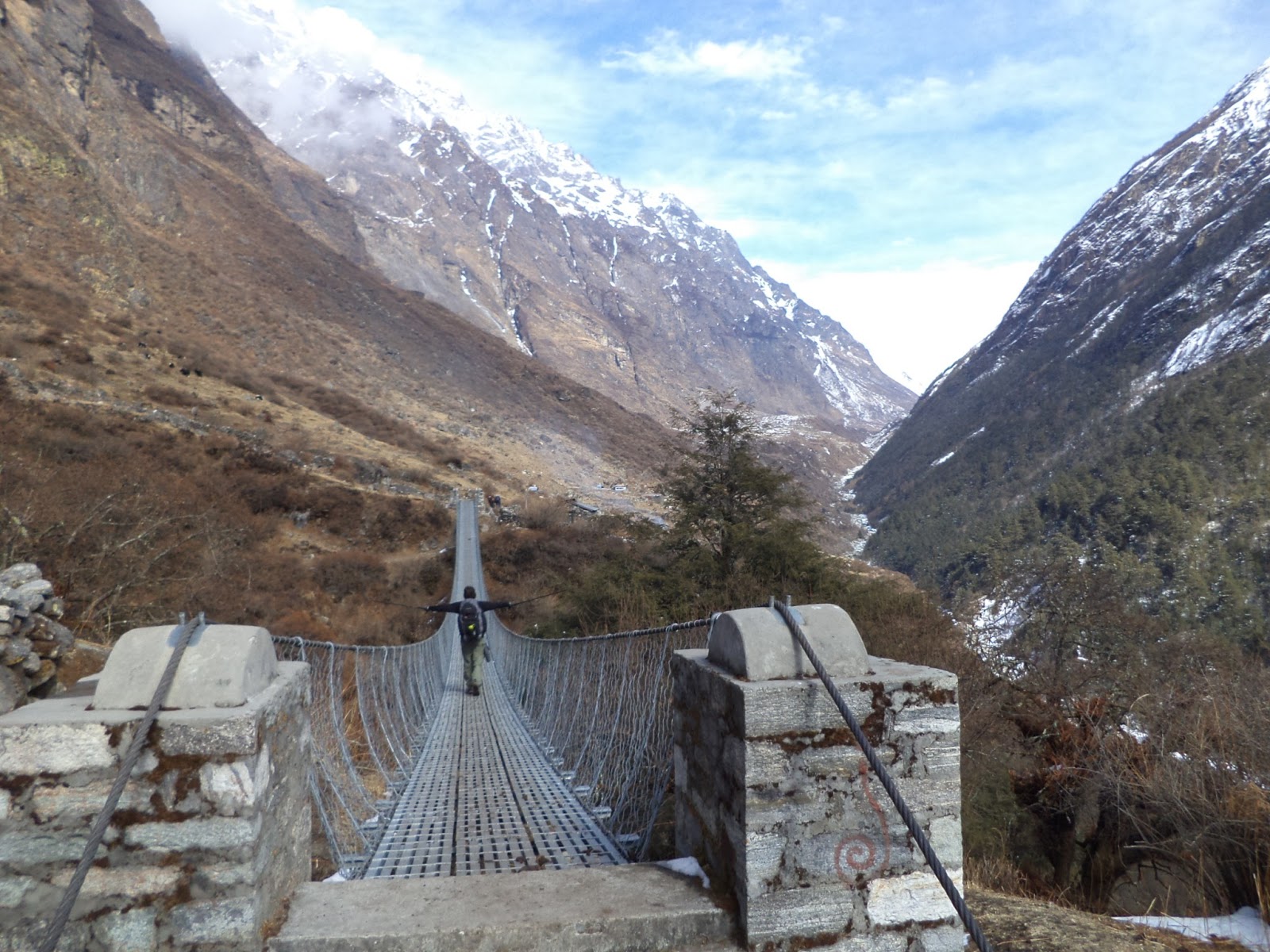
The first day was great: a perfect weather found us well-rested, energized and as excited as ever. We were greeted by a beautiful river and crossed some small villages and sturdy metal bridges covered with the ubiquitous multicolored prayer flags of the Tibetan Buddhists.

The beginning

The Langtang River

First village


After four hours trekking, we arrived at the first big teahouse, Bamboo Lodge, where we had lunch and some well-deserved rest.


And I thought I was tired by then...

First stop!

We were already very tired, and briefly considered spending the night there. However, as Bamboo Lodge was still halfway the distance we had intended to cover in the first day (first lesson learned: it is so much easier to plan for big treks from your hotel bed than with a 30kg backpack on your shoulders), we decided to put a little extra effort into it and go at least until the next teahouse, at Rimche. At Bamboo I also decided I was carrying too much weight (second lesson learned: your perception of what is essential to carry with you changes dramatically after having to carry those perceptions on your back uphill for six hours). I took off a good 5kg of trash from my luggage and the lodge’s owner kindly let me leave it all there to retrieve on my way back. After two more hours, we finally arrived at Rimche, where I almost immediately fell asleep.

Ready for more!

We woke up before the sun was up the next day and set out for the next leg in our journey.  The trail started getting more and more rough, but the scenery also grew more beautiful, with us getting closer and closer to the beautiful mountains ahead.


Halfway up!


At some points the trail was little more than a narrow strip separating as steep rock from the abyss at our side, and sometimes the teahouses on the way were little more than a single building defiantly sitting in the middle of the immensity of the valley. For me, all these impressions added up to create a surreal sense of reality, as if all of that was a particularly long dream.


At that point I was already sufficiently awe-struck to make this video (my ramblings are in Portuguese, sorry).


Up we went, uneventfully reaching our next goal: the teahouse called Hotel Peaceful in Chianki, where our friend Norbuk, the owner, was more than happy to provide us with his hospitality and 100-rupee tea cups.


In the mountain, especially at high altitudes, resources are scarce, and almost nothing gets wasted. The mountain people usually have Yaks (a beast resembling a small, hairy cow) for milk and fur – not for meat, though, because Tibetan Buddhists are not allowed to kill animals (if a Yak dies of an accident, however, it’s barbecue time!). The Yak dung is collected, dried, and then used as fuel, along with firewood, for the stoves that warm the chilling nights. We had never been so happy to see a big pile of dung before.


Yak dung for everybody!


On the third day of ascent, the world turned white. The trail became snow-ridden, the ground slippery, and the snowy peaks we used to admire from a distance now surrounded us from all sides.


And then, after some more hours of battling the knee-deep snow, we finally reached Kianjin Gumba, at 4000m high, our last inhabited stop.


Mighty Kianjin Gumba

In Kianjin Gumba, the rest of the day was devoted to resting, warming up, and being beautiful.


Please don't make me move...


In the morning of the fourth day we set out to climb the Kiang Ri, a “small” (at 4,500m, more than half an Everest, it was the smallest and most accessible peak around, just behind the village) friendly ice-covered rock. The climb was not very difficult, but it was tiresome. Personally, as I had never seen snow before this trip, I had a lot of trouble with the white crap: I would slip uncountable times, relying on my trekking poles to avoid falling and rolling down the slope to a horrible death.


Showing the mountain who's boss

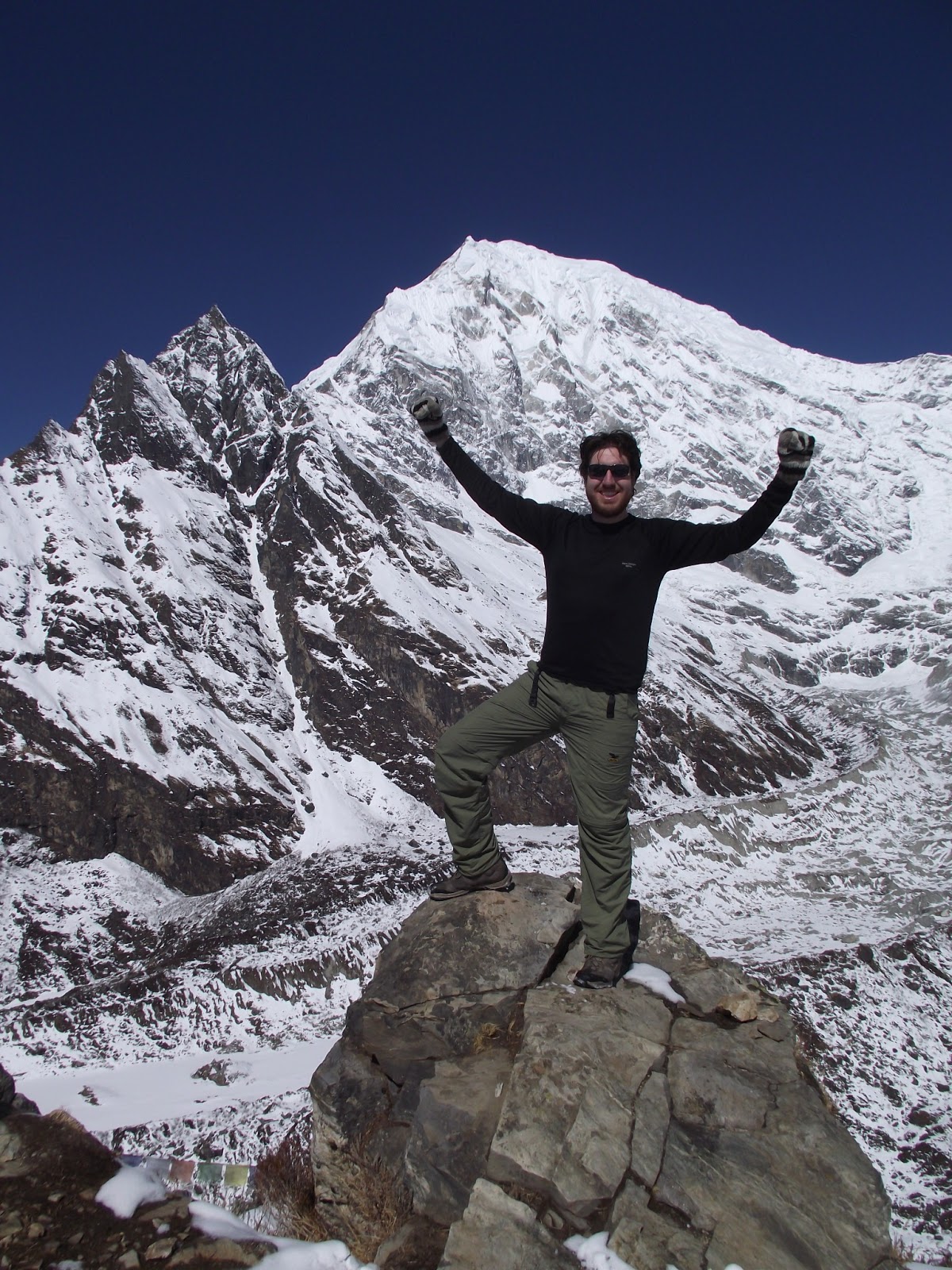
And then, three hours later, we finally reached the top, finding an exhilarating view of the valley around us, the glacier, and the surrounding peaks and mountains.


King of the hill


A bit of national pride


Lookin' good.


The valley of Kianjin Gumba


See the village down there?

We spent some time there, and I was surprised to know, on our way back, thar David had proposed to Sarah, at the very top of the mountain. How sweet is that??

The happy couple

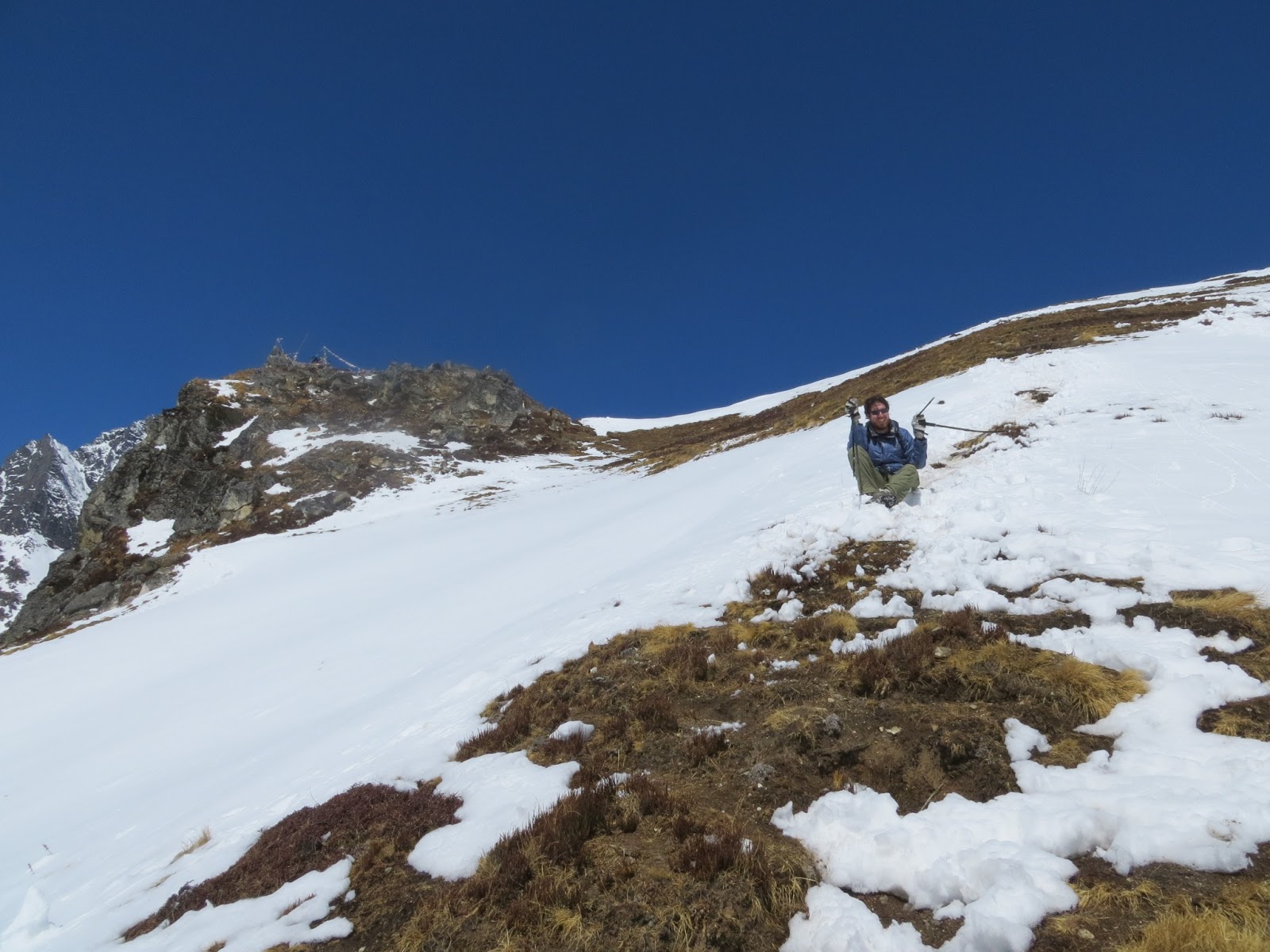
So we started our way down. The next three hours were the only part of the trek in which I felt genuinely afraid for my safety. The morning sun had half-melted the snow, making it ten times more slippery, and giving up more easily to our weight. To a greenhorn in both climbing AND dealing with snow such as me, that was serious trouble. Early into the descent, I slipped, fell to my butt and started sliding down the slope uncontrollably. Luckily I was able to reflexively stick my trekking poles in the ice and coming to a halt, but one of my trekking poles paid the price with its life: it was broken for good.

Ouch!

After that, without the trekking poles to rely upon, I started a careful descent on my own hands and legs. I took off my gloves for an extra grip, even though it was freezing cold, and decided to avoid the snow altogether, trying instead to go from rock to rock, bush to bush, even if that meant going a longer way. To the hell with my palms (which were really scratched) and my boots (which suffered their lot in silent agreement) – at the moment, I just cared about reaching the village alive and in one piece. Shaky and relieved, and in no mood for pictures, I finally arrived at our lodge, celebrating my success with a big belly-slide on the snow. Afterwards, I quickly found my way to food and bed, and slept as a rock.
On the next morning, it was time to say goodbye to our host, Kianjin Gumba, and start our long descent.


Kianjin Gumba from our doorstep


The way down was way faster and less tiresome, but it was no easier than the way up: our bodies were already tired from the exertion of the last four days, and going down is much harder on your knees and shoulders. Despite that, we made our way to Shyafru Bensi in only two days (as opposite to the three it took us to go up), in two 6-hour hikes. The last two hours were particularly tiresome: on top of being exhausted from all the trekking, the extra weight I had left at Bamboo Lodge really made me miserable until reaching our hotel room in Shyafru. Miserable, but happy as a little kid with a new Lego set. On his birthday. With cake. And a puppy.

Trekking on the Himalayas was an once-in-a-lifetime experience, one that will be engraved in mind for the rest of my life. It is as much a journey into oneself as it is a physical feat, as it gives you plenty of time to think and reflect on your life, combined with trance-like periods of intense concentration on the task at hand, as there are times in which a simple mistake can be fatal. I really feel like I have emerged as new being after this experience, and I will be forever grateful to Sarah and David for taking me along and offering me guidance, advice, and friendship.

Namaste!