quarta-feira, 1 de maio de 2013

The Wonders of Angkor Wat (and Siem Reap)


After spending a full 10 days in Bangkok, I finally left that great city, heading for mysterious Cambodia. My first destination was Siem Reap, a city known only for being close to the magnificent complex of ancient temples that includes Angkor Wat. I took a train from Bangkok’s Hualamphong station to the city o Aranyaprathed, 6km away from the Thai-Cambodian border. God, it was good to hit the road again.


During the 6-hour-long train ride, I had the pleasure of meeting some great new friends: Matt and Andrew from Canada, Ryan from the UK and Marlous from the Netherlands. We had a great time talking on the train, and decided to stick together until Siem Reap.

Andrew, Marlous and a curious monk

In Aranyaprathed we took tuk-tuks until the border. OF COURSE they tried to scam us leading us to fake visa offices. Luckily, we were aware of this age-old trick and demanded to be taken directly to the Thai immigration office. It was so incredibly hot, but after a little waiting and stamping, we crossed to Poipet, in Cambodia.

My first date with lady Cambodia - she is SURELY HOT!


Poipet has nothing but big casinos where Thai people go to gamble and people try to squeeze money out of tourists. We decided to avoid the “official” bus rides with “free” shuttles, and that earned us a nightmarish half-hour trying to find some transport. We finally found a minivan willing to take us all for a reasonable price. The catch: the driver had a table to deliver to somebody in Poipet and was still waiting for said somebody. His estimated 5 minutes quickly became 30, and we baked our souls to hell inside the van. Take a look at our misery:


The damn owner of the damn table finally arrived and we were on our way. Finally reaching Siem Reap, we had reservations in different hostels. The rest of the day was just about getting settled, having a well-deserved cold shower, meeting up for dinner, and planning the next day: next morning we were to watch sunrise at Angkor Wat, and I could barely hold my excitement. Visiting Angkor Wat was an old dream of mine, from history lessons and from playing Civilization. An hour before sunrise I met Matt, Andrew and Ryan (Marlous went with another friend) and we took our tuk-tuk to the temples.

Angkor Wat starts to impress you long before you first set sights on the ruins. For starters, the main temple is surrounded by a giant moat 1024 x 802 meters long and 190m wide. It’s mind-numbing just to imagine how much work and effort an ancient civilization had to build just that.

We entered the temple grounds and joined the hundreds of other tourists waiting for the sun. Although pretty, the sunrise was less impressive than I anticipated, a little too cloudy and too crowded. Still, beautiful pics.


As the day cleared, we got our first glimpse of the great structure itself:


This time, we decided NOT to join the crowds and go take a look at the rest of the complex first, and come back during a less crowded time to check Angkor Wat. Back to the tuk-tuk, we entered the magnificent complex.


Our first stop was a damn-expensive hut-restaurant. The great thing about this place is that you are surrounded by nature and ruins EVERYWHERE. So while waiting for the food we fooled around through some of them…


Levitating in 3... 2... 1...


After that we headed to Bayon, the biggest structure in the complex after Angkor Wat itself, known for its over 200 stone faces.

Front view of Bayon

Bayon’s carvings


Then we got close to the stone faces. They “officially” represent Lokesvara, one of the most famous bodhisattvas. However, the faces are said to rather resemble the king who ordered them built, to create the feeling that the king is always present, always watching. Indeed, there’s always one of them looking at you, wherever you may be in the temple.


Between a temple and another, a flash of the modern times we live in:

I don't have him on Facebook :(


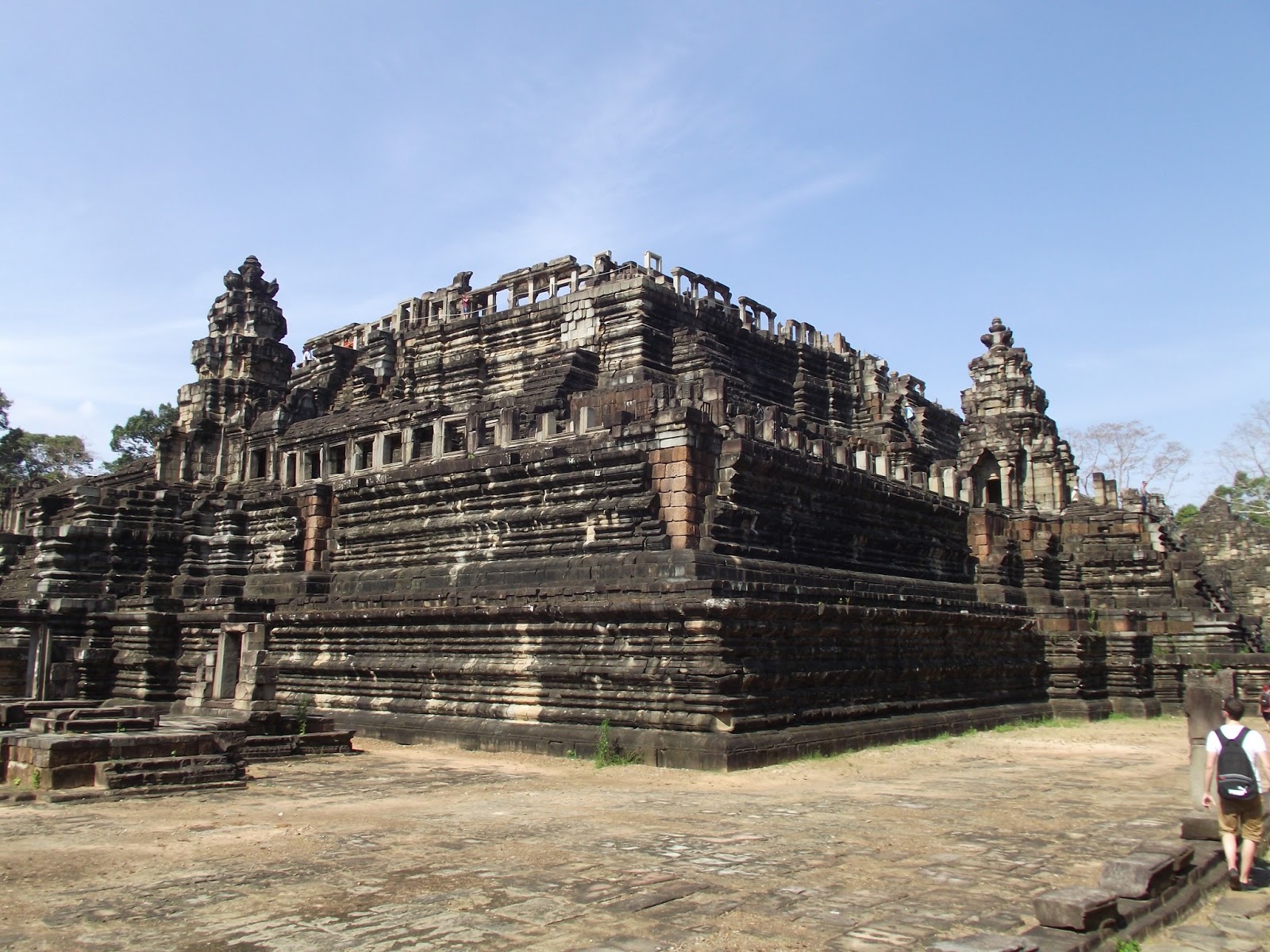
After that, we checked the Baphuon temple, which has an interesting story. In the mid-20th century, many of the 12th century temples had collapsed. A massive archeological effort was launched to rebuild them in 1960s, which had categorized the original positions of the stones around the temple. When the Khmer Rouge took power in 1975, these documents were lost. Many international teams work at the site today, literally trying to figure out the world’s largest jigsaw puzzle.

The walkway to Baphuon


The pieces of the puzzle


Our last stop was to be one of the temples used in the movie Tomb Raider movie. On the way there, we stopped from time to time to take pictures of impressive things around us.


The hall of elephants

The hall of elephants


Reaching that one required some walking in the jungle. That part of the complex has been badly damaged by the trees. One of the species here can reach up to more than 50m high. Its roots creep their way between the temple’s stones and literally crumble them from within.


It’s good to be considered small next to someone, sometimes…


The restoration work conducted there by the international teams is really, really impressive. Some signs show before-and-after pictures:


The reconstructed hall


And so, in the hottest of the day, it was time for the Gran Finale. Back we went to Angkor Wat. Seeing it in full light is every bit as astonishing as at dawn.


Climbing up the thing

The King of Angkor Wat

Me, Matt, Andrew and Ryan making four fools out of ourselves


And thus our exploration of the Angkor complex came to an end. Few places on Earth, if any, are capable of getting you utterly mind-boggled as this one. Even though I was glad to get out of the scorching heat, it was not without some grief that I looked at Angkor Wat for the last time. In my heart it entered the very exclusive hall of the things one has to see before dying, right there along with the Taj Mahal and the Himalayan mountains.

After getting back to Siem Reap and resting a bit, we met again for dinner and drinks in Pub Street, which well deserves its name.


Marlous was leaving the next morning, and I ended up not meeting any of my newfound friends anymore – Matt and Andrew turned back to Thailand and then headed to Laos, and I left for Phnom Penh before Ryan. We had a joint toast, however:


As if we hadn’t have enough for the day, we found a great place in Siem Reap lively nightlife. I was taught a great drinking game (Brazilians, brace yourselves) and we had a crazy and wild night! But that’s another tale…

Cheers!


terça-feira, 30 de abril de 2013

Experience: the Killing Fields, and the Tuol Sleng (S-21) Prison


Choeung Ek Killing Fields


This was arguably the hardest day of my trip, emotionally. Indeed, being lost among the marvels of Cambodia’s ancient past in the temples of Angkor Wat, or dealing with ever-smiling Cambodians can never prepare your heart to relate to the horror of the country’s recent events. So, before starting my tale, let me (very briefly) introduce you to this particular little bit of history.

During the course of the Vietnam War, fought between South and North Vietnam and with extensive involvement of foreign allies on both sides, conflict and fighting (and bombing) spread to the neighboring countries of Laos and Cambodia, leading to the creation, in the latter, of the Khmer Rouge (Red Khmer) – a communist radical insurgency group. Khmers are the majority ethnic group in Cambodia. Led by the revolutionary leader Pol Pot, this group fought a gradual guerrilla war against the government forces, being backed up by communist forces of North Vietnam and the Viet Cong. The Khmer Rouge took power in Cambodia after seizing the capital, Phnom Penh, in 1975.

Pol Pot wished to create a pure agrarian communist state in the country. Being suspicious of city-dwellers (regarded as parasites and lackeys of capitalism), he ordered the immediate evacuation of cities. In three days, the entire population of Phnom Penh (between 2 and 3 million) was ordered to move out and assigned to 12-hour-a-day forced labor in farm fields. As Pol Pot’s regime developed, violence against perceived “traitors of the revolution” escalated, leading to the creation of prisons, torture chambers and, ultimately, killing fields all over the country. An estimated 3 million people (out of a former population of 8 million) died under the rule of the Khmer Rouge.

For more information, I recommend the good Wikipedia articles on Pol Pot, the Khmer Rouge, and Democratic Kampuchea. I also highly recommend watching the 1984 movie The Killing Fields. So, upon arriving in Phnom Penh, I decided to visit one of the killing fields and the most famous political prison, to have a deeper understanding of that sad bit of human history.

The Choeung Ek Genocidal Center, created upon one of the killing fields in the outskirts of Phnom Penh, first impressed me by how lovely the place is. It was a sunny day, the place is clean, verdant and pleasant, and not at all what one would expect of such a location. On the front, there is a high memorial stupa. This quickly brings you back to reality – the stupa houses an incredibly high pile of more than 5,000 human skulls, part of the over 9,000 bodies found in that field alone. More on that later.


The memorial stupa


Choeung Ek wasn’t a concentration camp, as there was no forced labor here. One entered the place either to kill, or to die. The aim was to eliminate prisoners as quickly and efficiently as possible. The method was mainly bludgeoning, since the Khmer Rouge wouldn’t spend precious bullets for such a job. Executions were conducted only at night, to avoid raising suspicion of people and workers nearby. Prisoners would be walked to previously dug collective pits, killed on the spot, and thrown in the pit, much in the way illustrated below.


There are signs marking the places where the buildings (later destroyed by the Vietnamese) were. Two of them are particularly touching. During the height of its activity, more than 300 prisoners were executed every day here, more than the guards could handle. So a small prison, dubbed “the Dark and Gloomy Prison” was erected – just a windowless depot for storing human cargo to be executed during the next night. There was also a storage room for chemicals – those helped cover up the unbearable stench, and also served to kill any half-dead prisoners thrown in the pits while still alive.

Perhaps the best image of the Khmer Rouge’s utter disregard for life is provided by their own famous saying, aimed at the traitors: “To destroy you is no loss. To preserve you is no gain.”


There are many, many depressions in the soil around the site. These mark the former pits. The bodies were exhumed and moved to proper burial sites. However, during every rainy season the waters and erosion bring up fragments of bones, teeth, and cloth rags. Indeed, you can see many of them in the ground around your feet, one of the gloomiest visions I ever had. It’s almost as if the place itself will not let anyone forget the horror that happened here.


There is also a very good audio tour provided along with the entrance ticket. You can hear explanations about each part of the place, as well as stories from survivors of the Khmer Rouge’s prisons and camps. There are no survivors from Choeung Ek. It’s impossible not to be moved by the stories, or to to fight the tears as you try to imagine what it must have felt like to go through all of this. Suddenly, all your problems, suffering, and everything you ever thought hard or painful in your life seem small and insignificant – and they really are.

Bones collected from the ground

On this tree a huge loudspeaker was hanged every night, playing political songs, so as to disguise the place as a Khmer Rouge political meeting, and muffle the screams of the victims.


One of the most terrifying visions was the tree below. Here, the children and little babies of prisoners were killed. Standard procedure was to hold the child by the ankles, and then smash his/her head against the tree. The horror is simply unspeakable.


By the end of the circuit, you can visit the memorial stupa. Here, layers upon layers of skulls retrieved from the pits are kept. This is truly a terrifying vision. The skulls are just there, each of them belonging to a person who was once just like you and me – good and bad, loving and selfish, generous and greedy, all of them stripped from the greatest gift of them all. They are all just there, looking back at you, as if demanding answers for the horrible crimes committed against them.


So after all this, deeply upset and lost in thoughts, I decided to look for a restroom. Found one near the museum bordering the walls. After getting out, I heard a lot of laughter and happy, playful sounds. I looked over the wall:


Just beside the memorial there is a school for small children. There they were, doing that wonderful mess children do, completely oblivious to the terrible deeds that happened next door. Probably some of their relatives even were here. I found new hope upon seeing the school – there is the future of Cambodia, and I pray those children can build up a society that learns, and remembers.


Tuol Sleng (S-21) Prison


Most of the prisoners executed at the Choeung Ek killing fields were first detained at the S-21 Prison. This place was a high school before the Khmer Rouge took power. After that, all schools in the country were simply closed, as Pol Pot believed education was useless to the revolution, and corrupted the purity of the “old people”, the pure, agrarian peasant lifestyle. The building was renamed Security Prison 21, and turned into a prison and execution center for political targets, right in the middle of Phnom Penh.


Right in the front of the main courtyard, that looks just any other school grounds in the world – classroom buildings surrounding big playing fields – are the tombs of the 14 last victims of the center, the ones whose corpses were found there when the place was liberated by the Vietnamese. Between 17,000 and 20,000 people were imprisoned in Tuol Sleng, and out of those there are only 7 survivors, all of whom had some skill useful to their captors, such as painting or photography. Right there is also a big sign stating the code of conduct of the center.


One of the buildings was used as a detention unit, with wooden and brick cells adapted within the former classrooms.


In the detention building there is barbed wire in every open-air corridor. This was to prevent prisoners from committing suicide by jumping down.


The other building was used as an interrogation facility. Prisoners would be extensively tortured to reveal names and locations of friends and family, who would in their turn be arrested, tortured and sent to the killing fields.

Looks like a regular school...

One of the interrogation rooms, and a picture of how it was found

These poles were used by students for exercise, but the KR adapted them for torturing people by hanging them upside down into water containers

The torture tools


The Khmer Rouge, in an upsetting similarity with the Nazis, were extremely meticulous in recording all their activities. Prisoners were measured, photographed, given identification numbers and photographed again after torture and death. Lists would be checked and rechecked everyday to ensure that nobody escaped. Confessions, completely made-up and gotten under extreme torture, were written down and signed by the prisoners, who were then signing their own death sentence.


One of the prisoners actually smiled for the photo. I'm still wondering about what caused that smile.

Can you see the traitorous look of these children? Such a threat to the revolution.

Some of the prisoner profiles and confessions

There are plenty of photos of the bodies after torture in the Khmer Rouge’s archives, but I really couldn’t bring myself to photograph them.

I left S-21 with a bleak feeling about humanity. Perhaps the best question was one I’ve found on the walls of one of the cells in the detention building. Some previous tourist, doubtlessly assaulted by the same feelings I was experiencing then, wrote:

“Will we ever learn?”